



Blog
We’re glad you’re here!
Breathe deeply, grab your preferred coffee mug, and look through our blog.



AI “slop” and How It Affects Current AI Solutions

Hazel Nguyen
February 5, 2026
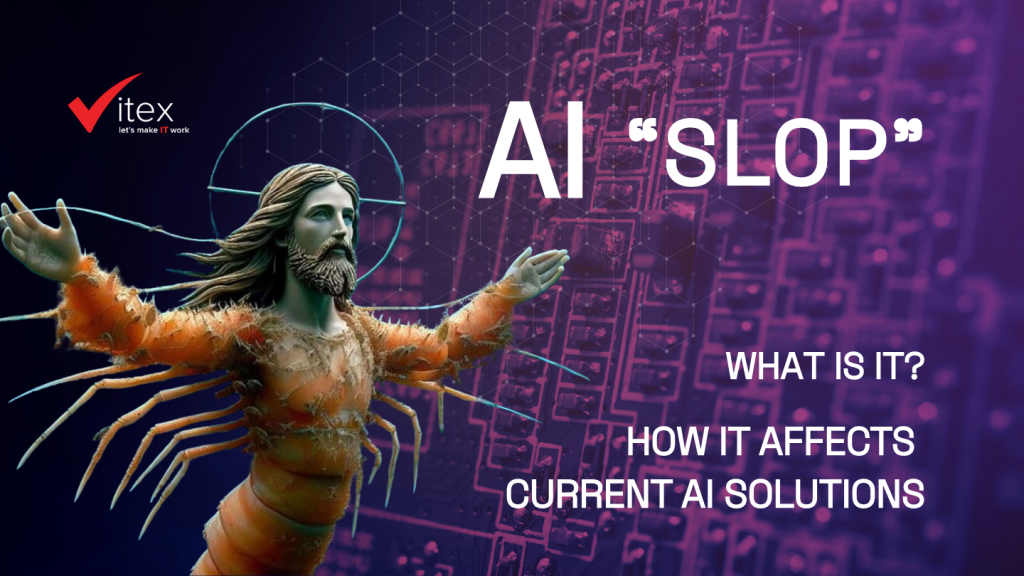
Artificial intelligence is reshaping how we create and consume content, but not all of what it produces is high quality. A growing issue in 2025–2026 has been the rise of “AI slop”: low-quality, generic, or misleading AI-generated material flooding the internet. The term slop (originally slang for pig feed) has become a way to describe digital content that may be technically AI-generated but lacks real value, accuracy. Not just a content problem, it’s a systems, data, and trust problem that directly affects how well your AI solutions perform today and how sustainable they’ll be tomorrow.
What is AI Slop?
AI slop refers to the vast amounts of content that AI tools produce with minimal effort. This includes repetitive text, meaningless images and videos that spread widely across social media and websites. In recent years, platforms have struggled with an influx of such content, and users increasingly report seeing bizarre, sometimes outright false AI creations on their feeds.
Why AI Slop Is a Real Risk for IT Companies
For most leaders, the real risk isn’t that AI suddenly breaks down. It’s that performance slowly downgrades, which is hard to notice.
Research shows that when models are trained on too much synthetic or low-quality data, they can sound strongly confident, but deliver worse results. An arXiv study on synthetic-data feedback loops found that even very large models start to drift when they learn from their own outputs.
In real systems, this shows up as:
- More shallow answers
- Less accurate predictions
- Different results for questions that should be similar
The hardest part is that nothing fails dramatically with everything looking fine on the surface, while quality lowkey declines.
How AI Slop Affects Operational AI Systems
AI slop becomes especially dangerous when AI is used for operational or decision-support tasks such as monitoring, alerting, forecasting, or recommendations.
When low-quality outputs feed into these systems, teams often see more alerts but fewer actionable insights. Confidence in AI-generated recommendations increases, while actual decision quality declines.
How AI Slop Reduce Public Trust on AI

As AI-generated content and systems become more visible, AI slop doesn’t just affect internal performance, it directly shapes how people trust AI. When users repeatedly encounter answers sounding intelligent but wrong, vague explanations, or low-effort AI outputs, trust drops fast. People don’t usually blame the model architecture or the data pipeline; they blame AI itself.
Over time, this creates a credibility gap. Users start double-checking everything, ignoring AI recommendations, or avoiding AI-powered features altogether. This effect has already been observed in public-facing tools, where repeated low-quality outputs lead to skepticism rather than adoption. Research and reporting show that once trust is lost, adding more AI features doesn’t help, it often makes the problem worse.
The Bottom Line
AI slop isn’t just digital noise, it’s a real challenge for today’s AI landscape. Left unchecked, it can weaken search quality, worsen model reliability, and erode public trust in AI systems. Addressing slop requires smart detection, human-centered content standards, and a clear strategy that treats AI as a tool to support real expertise rather than replace it entirely.





WRITE A COMMENT