



Blog
We’re glad you’re here!
Breathe deeply, grab your preferred coffee mug, and look through our blog.



Claude Code Security: Safer or Riskier? A Practical View for Tech Leaders

Hazel Nguyen
March 2, 2026
AI-assisted code scanning is not new, we have already had CrowdStrike’s Charlotte and Microsoft’s Copilot Security. But what scanned code, how they scanned it, and what they missed has changed dramatically in the last year. The release of Claude Code Security, a research-preview tool designed to identify vulnerabilities across entire codebases and propose patches, has pushed this conversation straight into the boardroom.
The big question for tech leaders now is simple:
Does Claude Code Security make your organization safer or introduce a new class of risks you’ll have to manage?
Let’s unpack this with clarity and realism.
What Claude Code Security Actually Does
Claude Code Security functions as an AI-powered code scanner. It analyzes codebases end-to-end, surfaces issues like logic bugs and broken access controls, and proposes fix suggestions developers can review.
What makes this noteworthy is not the concept itself, security scanning tools have existed for long but the performance… According to Anthropic, the tool surfaced more than 500 previously undetected vulnerabilities in audited open-source projects. If accurate, this suggests AI-driven analysis is beginning to exceed the recall of traditional static application security testing (SAST).
This raises an immediate, important takeaway:
AppSec is entering a phase where AI can spot subtle patterns, cross-file logic flaws, and multi-step vulnerabilities that humans and legacy scanners routinely miss.
Why the Market Reacted So Strongly
Shortly after the announcement, several major cybersecurity stocks dropped sharply 6-14% declines for companies focused on identity, endpoint, and cloud security. In a single session, roughly $10–15 billion in market value was erased.
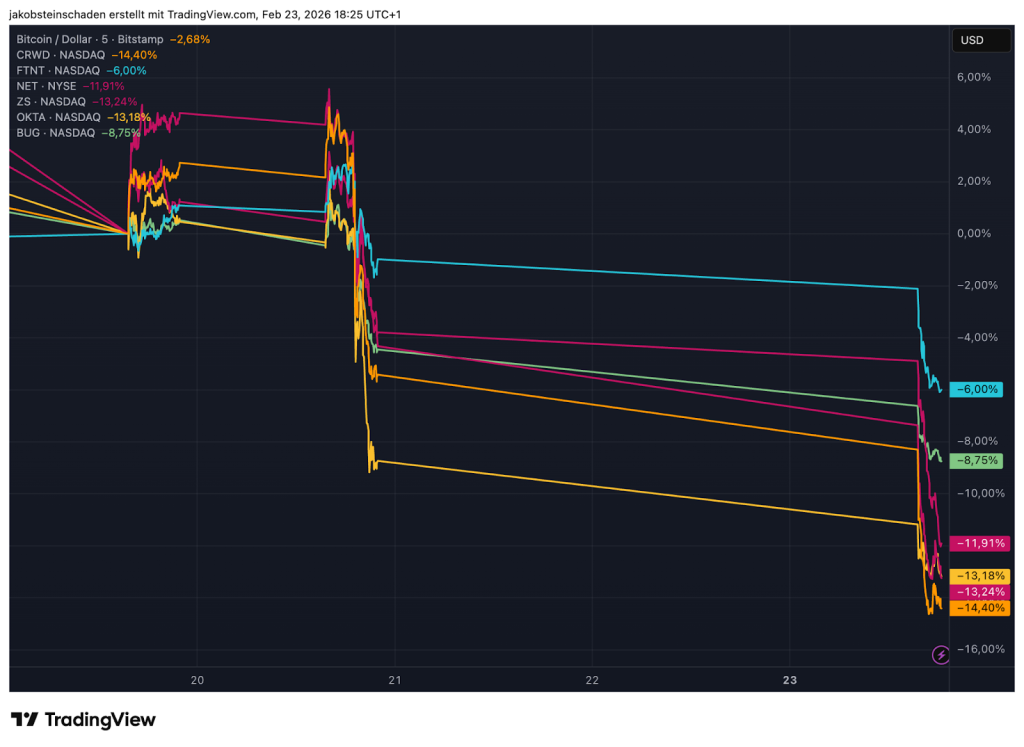
Source: TradingView
A major reason cybersecurity stocks plunged is that many investors misunderstood what Anthropic actually released. The scanning results that made headlines came from a research workflow where Claude reviewed FOSS repositories, analyzed git commits containing past vulnerability fixes, and extrapolated similar patterns across the codebase, followed by a human filtering process to validate the findings. That’s valuable security research, but it is not the same as an autonomous, production-ready code-security product. Anthropic then framed this work as a preview tool partly on the logic that if AI can detect these vulnerabilities, attackers can too, so maintainers should be alerted. The framing makes sense defensively, but it also conveniently positions Claude as a responsible alternative at a time when competitors are moving aggressively into AI-security tooling.
Because most of the market reaction came from non-technical investors, the narrative quickly escalated into “AI is about to disrupt cybersecurity end-to-end.” In reality, the tool scans code; it doesn’t replace SOC functions, identity platforms, or endpoint security. Yet the combination of impressive research results, strategic packaging, and general AI hype created the impression that a foundational shift was underway. The truth is more measured: Claude Code Security signals real progress in AI-assisted AppSec, but not an existential threat to the broader cybersecurity ecosystem, at least not in its current form.
Does AI Code Scanning Make You Safer?
In many ways, yes.
AI dramatically expands coverage.
Traditional SAST tools struggle with cross-file reasoning and business-logic flaws. AI can track these patterns more holistically.
It reduces “unknown unknowns.”
The ability to surface issues in previously audited codebases suggests that even mature engineering organizations underestimate their vulnerability footprint.
It accelerates secure development.
Patch suggestions, even if imperfect, reduce developer cognitive load and raise the baseline quality of fixes.
It levels the playing field.
Teams without deep AppSec expertise gain access to stronger automated review, narrowing the gap between large enterprises and fast-growing mid-market companies.
For organizations with limited AppSec bandwidth, the benefits are immediate and tangible.
But the Safety Story Has Another Side
AI-enabled code scanning also introduces risks and operational considerations. The tool itself doesn’t cause the risk, how organizations rely on it does.
1. Over-reliance on AI recommendations
A patch generated by an AI model still requires human validation. If teams become dependent on automated suggestions, logic errors could slip through a different door.
2. False confidence and incomplete scanning
A strong scan does not equal a comprehensive scan. Leaders must avoid assuming coverage is total.
3. Sensitive code handling
Even with enterprise-grade privacy controls, sending full codebases to external AI systems raises governance and compliance questions. This is especially true in regulated industries.
4. Talent pipeline disruption
Junior AppSec and code-review roles may face the most immediate pressure. These roles historically served as the entry point to more senior security engineering careers. Organizations should begin thinking about how to develop early-career talent in an AI-accelerated world.
5. Vendor concentration risk
If too much of the security workflow becomes dependent on a single model class or provider, systemic risk increases. This is not theoretical, supply-chain attacks have shown how fragile concentrated dependencies can be.
The technology is powerful. But like all powerful technology, it must be integrated with discipline.
So… Safer or Riskier? The Real Answer
Claude Code Security makes organizations safer, if adopted with the right guardrails. It becomes risky only when it replaces human judgment rather than enhancing it.
AI-driven code scanning should be seen as an augmentation layer, not a replacement layer.
It extends what engineers can detect, accelerates secure development, and shifts security left in ways that were not economically possible before. However, the strategic risk lies in organizational behavior: over-trusting automation, neglecting AppSec fundamentals, and assuming one tool can replace the broader defense-in-depth ecosystem.
The companies that will benefit most are those that:
- integrate AI scanning into existing secure SDLC processes,
- maintain human review at the right checkpoints,
- invest in upskilling developers on interpreting AI-generated findings, and
- plan for long-term impacts on security talent and vendor strategy.
Final Thought for Tech Leaders
AI will not eliminate the cybersecurity stack. But it will reshape it.
Claude Code Security is a preview of that shift, not because it replaces SOCs or endpoint tools, but because it demonstrates that certain security capabilities can be automated earlier and faster than expected.
The organizations that get ahead of this now, balancing adoption with governance, will be the ones that build safer software, reduce vulnerabilities, and spend less on remediation long before their competitors catch up.



WRITE A COMMENT