



Blog
We’re glad you’re here!
Breathe deeply, grab your preferred coffee mug, and look through our blog.



Monolith vs Modular Monolith vs Microservices: How to Choose the Right Architecture

Hazel Nguyen
February 3, 2026
Architecture is one of those topics that can easily get overcomplicated. People debate endlessly about what’s “modern” or “best practice,” but the truth is simpler: each architecture has its own place, its own strengths, and its own timing. At Vitex, we see this play out every time we help a client build or scale a digital product. What matters isn’t choosing the most popular structure, it’s choosing the one that matches the reality of your business growth stage.
Software Architecture
Software architecture often sounds like a technical term reserved for engineers, but in reality, it’s simply the blueprint or the roadmap of how your software is structured. However, those contained in those blueprints are what is hard to be defined, as stated by Mark Richards and Neal Ford.
Therefore, software architecture patterns should be chosen depending on the software on the software’s maturity, complexity, and growth vision. A product in its MVP phase shouldn’t be organized the same way as one serving millions of users. Three patterns matter the most for modern product teams: monolith, modular monolith, and microservices.
1. Monolithic Architecture – For an effective kickstart
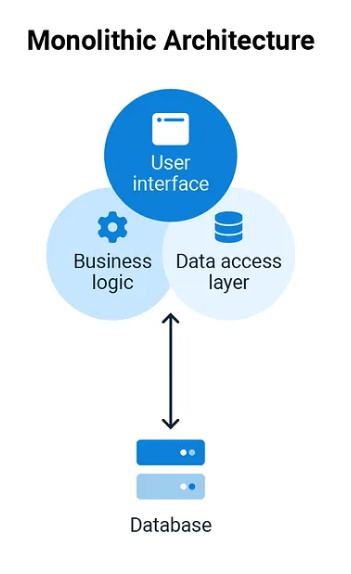
A monolith is one unified system where everything lives in one codebase and runs as a single application. It’s simple, straightforward, and extremely fast to build. That’s why most successful startups, including today’s tech giants (Github, Netflix, AirBnB..) began this way.
Monoliths are ideal for early-stage products because they reduce complexity. When you’re still shaping your idea, iterating weekly, and validating the market, having everything in one place allows your team to deliver quickly without heavy DevOps work. However, if many developers work on the same codebase, it is hard to maintain. Just one bug can bring the entire system down.
Monolith is best for:
- MVPs
- Early-stage startups
- Small teams moving fast
2. Modular Monolith – The transitional step
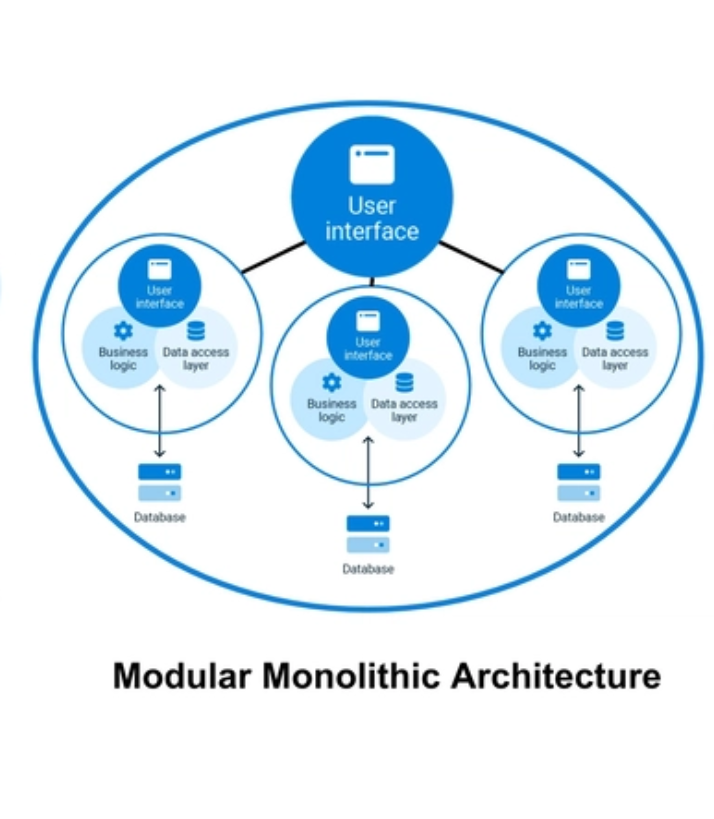
Somewhere between “just launched” and “scaling fast,” the monolith starts to feel crowded. There are more features, more engineers, more dependencies. But instead of jumping straight into microservices (which many teams are tempted to do too early), there’s a more sustainable middle ground: the modular monolith.
A modular monolith is the natural next step. The system is still one application, but internally it’s organized into well-defined modules or domains. This structure brings clarity without the action of splitting into multiple services.
Teams can work more independently, features become easier to maintain, and the overall system becomes more stable, all without the complexity of running distributed services. However, if a team fails to respect boundaries, the system might break down.
Modular monolith suits:
- Post-MVP, growing products
- Teams expanding from 3–5 developers to 10+
- Product-market-fit stage
3. Microservices – Comes with complexity and scalability
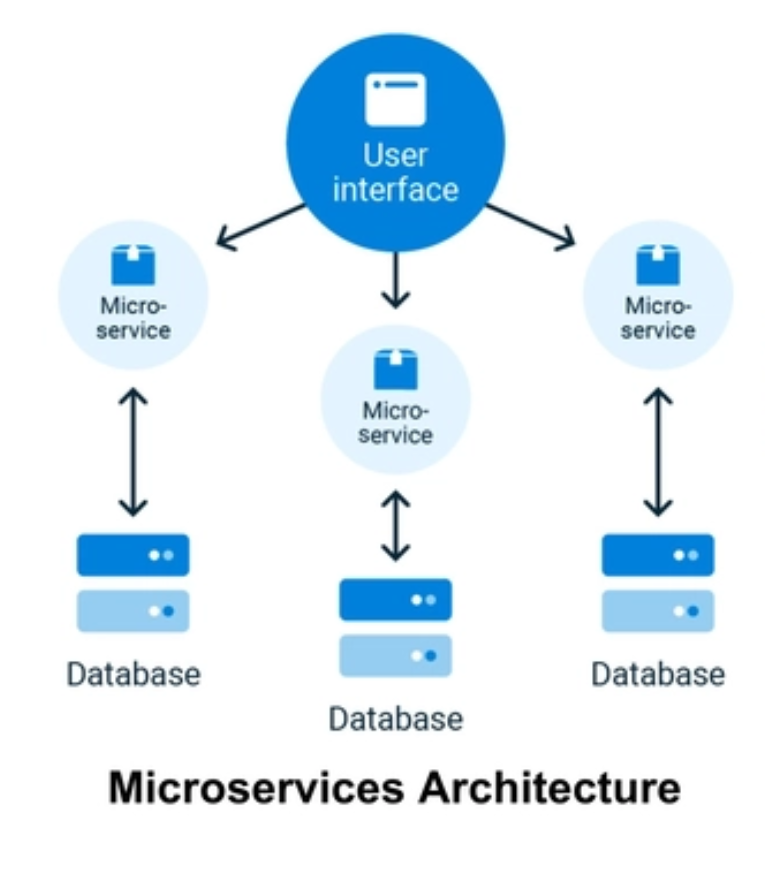
Microservices take modularity to the next level. Instead of one application, the system is divided into a collection of multiple independent services, each with its own codebase, database, and deployment pipeline. This is powerful, but it comes with significant operational demands.
Microservices shine when products grow large, traffic spikes, and teams work on different areas simultaneously. Features can scale independently, releases become faster, and the system becomes more resilient. But this level of independence requires serious engineering effort: monitoring, communication, DevOps, and cloud infrastructure, introducing heavy operational cost.
Best for:
- Scale-ups and enterprise systems
- Products with complex domains
- High-traffic platforms
Summarization
| Architecture | What It Is | Best for | Benefits | Challenges |
| Monolith | One unified application | MVPs, early-stage startups | Fast to build, simple to maintain, low cost | Harder to scale later, features coupled |
| Modular Monolith | One system with internal modules | Growth stage, post-PMF | Organized, maintainable, prepares for scaling | Requires good discipline in structure |
| Microservices | Many independent services | Scale-up, enterprise level | Independent scaling, faster deployments, resilient | High complexity, expensive infrastructure |
There is no “best” architecture, only the right one for your current maturity. You should start simple, evolve gradually and confidently, and scale when the product and team are ready.






WRITE A COMMENT