



Blog
We’re glad you’re here!
Breathe deeply, grab your preferred coffee mug, and look through our blog.



What is AIOps? Why Companies should adopt AIOps

Hazel Nguyen
January 30, 2026

As digital systems grow more complex, IT teams struggle to monitor performance, detect issues, and respond quickly using traditional, manual workflows. Artificial Intelligence for IT Operations (AIOps) is emerging as a critical solution to these challenges.
According to Fortune Business Insights, the global AIOps market was valued at 2.23 billion USD in 2025 and is projected to reach USD 11.8 billion by 2034, with a 21.4% CAGR. This rapid growth shows how essential AIOps has become for organizations operating in modern, distributed environments.
This article explains what AIOps is, why it matters in 2026, and how businesses can benefit from adopting it.
What Is AIOps?
AIOps (Artificial Intelligence for IT Operations) AIOps combines big data and machine learning to automate IT operations processes, including event correlation, anomaly detection and causality determination. It analyzes large amounts of logs, metrics, and events to detect unusual behavior, reduce noisy alerts, predict potential outages, and provide clear insights that make IT operations easier to manage. AIOps helps organizations handle the growing complexity of modern IT systems with more automation and fewer manual, repetitive tasks.
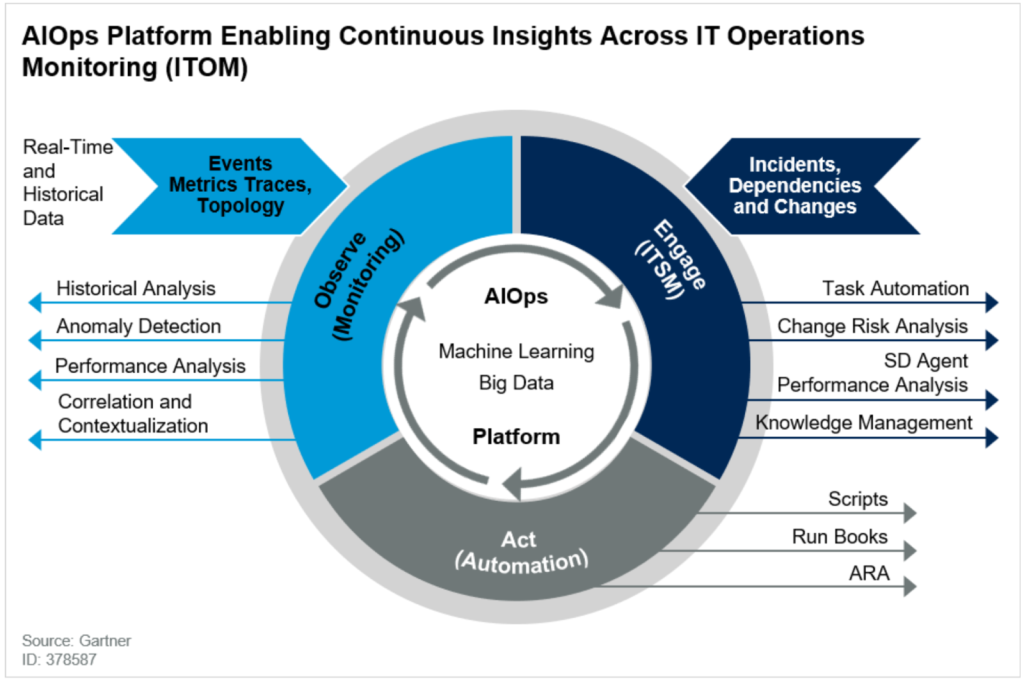
How AIOps work
AIOps platforms rely on three core technologies: natural language processing, machine learning, and automation – to help teams monitor, manage, and maintain IT systems more effectively.
Natural language processing (NLP) allows AI to interpret human language, making it possible to analyze documentation, logs, and code without rigid rules. This helps AIOps tools understand context, detect inconsistencies, and support more flexible, intelligent workflows.
Machine learning (ML) enables AI to find patterns in large volumes of operational data. With ML, AIOps platforms can improve detection accuracy, identify root causes faster, and predict potential incidents before they disrupt the system.
Automation gives AIOps the ability to take action with minimal manual input. Automated workflows help IT teams resolve issues quickly, reduce repetitive tasks, and ensure consistent performance across complex environments.
AIOps work best in
AIOps is being adopted fastest in areas where IT teams face the highest levels of complexity, data volume, and pressure for real-time reliability.
- IT & Telecom
- Banking and Financial Services (BFSI)
- Retail and E-commerce
- Healthcare
- Government and Public Sector
- Manufacturing
These industries rely heavily on uptime, fast incident response, and large-scale digital operations, making AIOps a natural fit.
Key Benefits of AIOps for Modern IT Teams
AIOps delivers significant value for organizations operating complex, distributed systems by combining real-time monitoring, predictive analytics, and intelligent automation.
Reduced downtime
By continuously analyzing logs, metrics, and events, AIOps detects anomalies early, predicts potential failures, and triggers accurate alerts, allowing teams to respond before issues escalate further.
Root cause analysis
Instead of manually reviewing logs or toggling between tools, AI correlates data from across infrastructure, applications, and environments to trace the source of a problem. This shortens investigation time and helps teams restore services faster.
Lower Operational Effort
Simple tasks and checkups can be automated, reducing manual work and freeing engineers to focus on higher-value activities. This automation also minimizes human error and ensures more consistent handling of incidents.
Enhancing collaboration and visibility
By centralizing operational data into a unified platform, developers can work from the same insights, and respond to incidents more efficiently.
Challenges leaders should approach with caution
While AIOps brings a lot of value, leaders should be aware of a few challenges before jumping into implementation. The first is data quality and fragmentation.
AIOps works best when it has access to clean, consistent data from all your tools and environments. If logs, metrics, and events are scattered or poorly structured, the system won’t produce reliable insights. Many organizations need to streamline their monitoring and connect their data sources before AIOps can perform well.
Another challenge is putting too much trust in automation too quickly. Automated actions can save time, but if they aren’t set up carefully, they can cause unexpected changes or trigger the wrong workflows. The safest approach is to introduce automation gradually, set clear rules, and keep humans in the loop until everything is stable.
Skills and readiness are also important. Not every team is familiar with AI-driven processes or how to interpret model insights. Without proper training, teams might ignore important recommendations or use the system incorrectly. Leaders should plan for onboarding and skill development to get the most out of AIOps.
Finally, there’s the challenge of choosing the right tools. AIOps platforms vary widely in features, integrations, and complexity. Picking a solution without clear goals often leads to higher costs and disappointing results. It’s more effective to start with a well-defined use case, measure outcomes, and expand once there’s proven value.
In conclusion
AIOps is becoming essential for teams managing today’s complex, fast-moving IT environments. By combining machine learning, automation, and real-time analytics, it helps organizations spot issues early, reduce manual work, and keep systems running reliably at scale.
For leaders, the takeaway is clear: AIOps delivers real value, but only when it’s implemented with clean data, the right skills, and a thoughtful plan for automation. Organizations that adopt it step by step will be better prepared to support growth, reduce operational pressure, and build more resilient digital systems.
As 2026 continues, AIOps will remain a core capability for any company aiming to stay proactive, efficient, and competitive.
Before implementing AIOps, companies need reliable DevOps processes, scalable infrastructure, and skilled engineering teams.
Building these foundations early can significantly reduce risks and costs when adopting AIOps in the future.






WRITE A COMMENT