



Blog
We’re glad you’re here!
Breathe deeply, grab your preferred coffee mug, and look through our blog.



DeepSeek Outage: A Wake-Up Call on Compute Demand

Hazel Nguyen
April 7, 2026
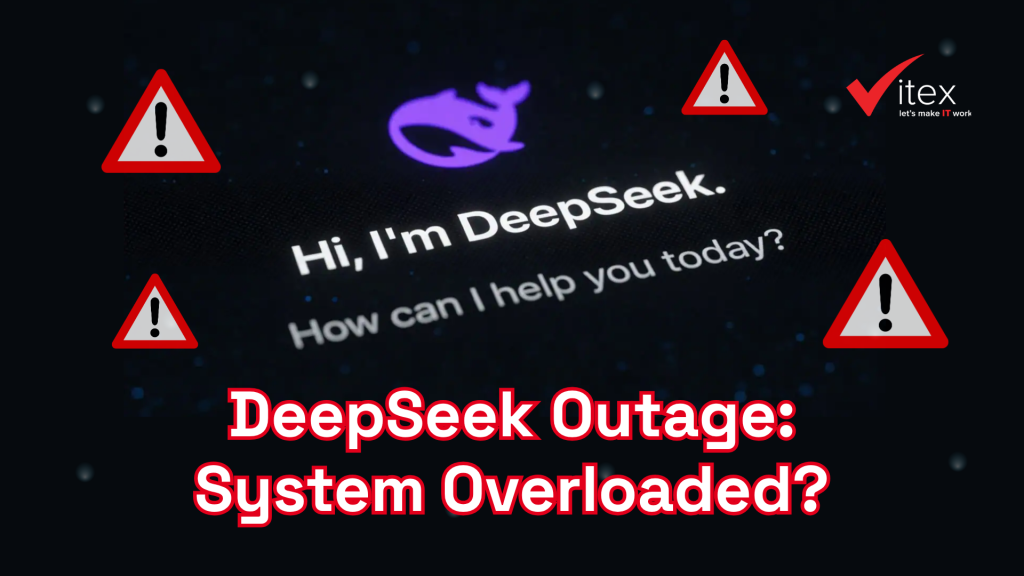
The recent DeepSeek outage wasn’t “just another short downtime.” It signaled something bigger: surging AI adoption is pushing global compute demand to its limits. For tech leaders, this is a timely reminder that resilience strategies must evolve as fast as AI workloads do. Below are the critical lessons, and what they mean for your infrastructure and business planning.
The Outage That Revealed a Global Constraint
During March 29–30, 2026, DeepSeek experienced its largest service disruption since launch. Based on aggregated incident trackers and user reports:
On March 29, 2026 at around 21:35 CST, DeepSeek’s AI chatbot began failing at scale. Users worldwide reported errors such as “server busy” and non-responsive sessions. Monitoring sites like downforeveryoneorjustme.com confirmed that the service was unreachable for large regions.
Although service was briefly marked as “resolved” around 23:23 CST, the platform went down again shortly after. The instability continued through the night and into the next morning.
Full service recovery was observed at 10:33 AM on March 30, 2026, meaning the disruption lasted 7 hours 13 minutes, with some sources noting up to 10+ hours of cumulative downtime depending on regional impact.
DeepSeek did not issue an official explanation for the incident. Industry watchers speculated that the outage could be linked to:
- a sudden surge in traffic,
- backend infrastructure stress,
- ongoing upgrades related to new model releases (e.g., the upcoming V4 architecture).
This event is now considered the most significant outage since DeepSeek’s global rise in early 2025, surpassing previous brief disruptions that rarely exceeded two hours.
AI Workloads Create Unpredictable “Demand Shockwaves”
AI systems (especially large inference models) operate very differently from traditional SaaS products. Each request triggers significant GPU activity, so even a modest traffic increase can place outsized pressure on compute infrastructure. This creates what has been previously described as “demand shockwaves”, the same phenomenon driving the global electricity strain written in our post on AI-induced energy shortages.
In practice, this means:
A seemingly small 10% rise in users can inflate compute requirements by 40–70%.
Peak hours become more volatile because users typically submit heavier, multi-step tasks.
Traffic is harder to stabilize since prompts and inference workloads are inherently uncacheable.
DeepSeek’s outage is a textbook example of this dynamic: even well-planned GPU scaling can be overwhelmed when usage surges faster than infrastructure can expand.
The Bigger Picture: We’re Hitting the GPU Supply Ceiling
The outage also highlighted an uncomfortable truth: the global GPU market is strained.
Cloud providers already face shortages, long lead times and unpredictable allocation windows for advanced chips.
When a platform like DeepSeek suddenly needs 2–3× more compute:
- There may simply be no extra GPU clusters ready to spin up.
- Even hyperscalers struggle with allocation limits.
- AI companies must compete for the same constrained supply.
This isn’t a DeepSeek problem, it’s an industry-wide bottleneck.
What Tech Leaders Should Learn, and Act On
To navigate this era of compute volatility, leaders need to rethink resilience across three layers:
- Architectural resilience
Shift from monolithic inference clusters toward distributed, multi-cloud, multi-region models. This reduces blast radius and gives teams more flexibility to route workloads during demand spikes.
- Demand forecasting with AI-native metrics
CPU-based forecasting doesn’t work for GPU inference.
Leaders should track:
- Tokens-per-second consumption
- Peak concurrency patterns
- Model-size elasticity
- Prompt complexity trends
These AI-specific signals provide far clearer early warnings.
- User experience fallback modes
When capacity saturates, having a “graceful degradation plan” protects trust.
This may include:
- Queueing instead of failing
- Offering reduced model precision
- Prioritizing paid tiers
- Delaying background jobs
Forward-thinking teams design for failure, not around it.
The Strategic Lesson: Compute Is Now a Business Dependency
Leaders often see compute as a technical asset, but DeepSeek’s outage reminded us it’s now a core business dependency, as critical as revenue or operations.
Those who plan for compute volatility will scale safely. Those who underestimate it will face outages, user frustration, and brand risk.




WRITE A COMMENT