



Blog
We’re glad you’re here!
Breathe deeply, grab your preferred coffee mug, and look through our blog.



Project Breakdown: A LBS Project Deployed With 100% Deadlines Met

Hazel Nguyen
May 4, 2026
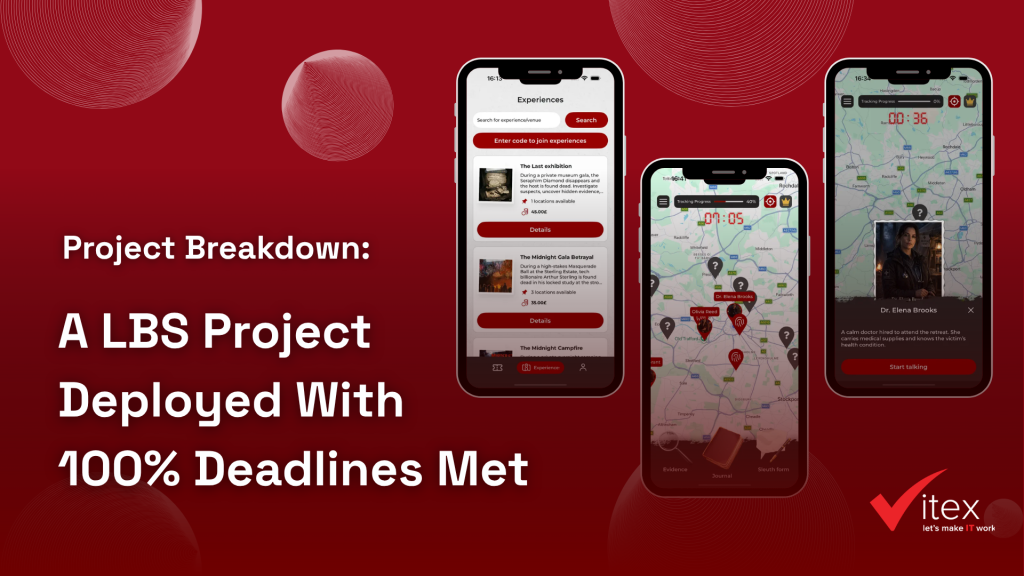
This is a location-based mystery game that blends Augmented Reality, real-world GPS triggers and e-commerce into one unified ecosystem. But the real story sits behind the scenes: how the team delivered a full CMS, Mobile App and Web Portal, within only four months, while meeting a hard festival launch deadline.
This breakdown explains how the system was architected, why a modular-first approach mattered, and what tech leaders can learn when building time-sensitive digital ecosystems.
The Challenge: A High-Stakes, Zero-Slip Timeline
The client needed a fully operational, three-tier platform: CMS + Mobile App + E-commerce Web Portal, ready for a critical May festival window. This meant every missed sprint risked missing the entire market opportunity.
According to the project document, the system had to:
- Deliver global scalability (deploying one storyline across multiple countries instantly).
- Maintain GPS accuracy in unpredictable urban environments.
- Ensure seamless monetization through omni-channel ticketing.
These requirements created a unique pressure: build fast, build reliably and ship without technical debt, especially around location-based logic, which is notoriously fragile under time constraints.
The Strategic Breakthrough: Modular-First Development
Instead of following a linear development path, the team intentionally decoupled the narrative engine from the GPS infrastructure. This allowed separate teams to work in parallel rather than waiting for one another.
The project report states that this architectural decision “secured a 30-day buffer for UX refinement,” a luxury rarely seen in LBS (Location-Based Service) projects.
Parallelizing the workload across CMS, Web, and App helped avoid the usual bottlenecks caused by waiting for mapping engines or content systems to stabilize. This is a valuable lesson: Modularity in this case is a strategic tool for protecting deadlines.
What Was Built: A Three-Pillar Ecosystem
CMS: The Operational Brain
The CMS wasn’t just an admin page. It was built as a global control center capable of:
- Deploying detective storylines across any GPS coordinates
- Supporting dynamic, region-specific pricing
- Tracking user progress and real-time ticket sales
This gave the client what the project notes emphasize: “operational autonomy without ongoing technical support.”
Mobile App: Real-World Gameplay
The React Native app enabled:
- Real-time GPS-triggered clue unlocking
- AR-based evidence collection
- A competitive leaderboard with automated certificate generation
The team overcame “GPS drift in high-density areas” using advanced filtering logic, an issue LBS teams often underestimate.
E-commerce Portal: Monetization Layer
The web portal allowed users to:
- Browse and purchase experience tickets
- Sync accounts so purchases on web activated instantly in the mobile app
This “Buy on Web, Play on App” model ensured conversion didn’t break between platforms.
Execution Discipline: Hitting 100% of Milestones
The team met every single milestone across a four-month roadmap in projects combining AR, GPS logic and multi-platform development.
This level of consistency required:
- Iterative field testing in real streets
- Tight collaboration between CMS, App and QA teams
- Continuous monitoring of GPS accuracy
- A buffer used solely for UX polishing
This illustrates why scoping discipline and early technical risk mitigation matter far more than flashy features in the early phases.
Outcomes: A Launch-Ready Global Platform
By the end of the project, the team and client reached:
- Launch readiness for the May festival campaign
- A stable omni-channel ticketing system
- A scalable location-based framework that can support future games
Lessons for Tech Leaders
The project leaves a few valuable takeaways applicable well beyond gaming:
1. LBS systems behave like living organisms
Real-world conditions: crowds, buildings, weather can break the logic you thought was sound in the lab.
2. Parallel development is the only way to win tight timelines
If your architecture doesn’t support modularity, your project schedule won’t survive real-world pressure.
3. UX buffers must be intentional, not accidental
A product that “works” but feels clunky will fail in experiential markets.
These principles are transferable to any tech project that blends physical and digital user journeys.
Final Thoughts & CTA
The project will launch this month – May 2026. This project demonstrates what disciplined engineering, modular architecture and precise execution can achieve under pressure. If your organization is exploring AR, LBS, or multi-platform ecosystems, the right partners and development strategy will determine whether you hit your market moment or miss it entirely.Want to explore how Vitex builds scalable, real-world digital experiences? Read more on our site or reach out to discuss your next project.


WRITE A COMMENT