



Blog
We’re glad you’re here!
Breathe deeply, grab your preferred coffee mug, and look through our blog.



The Claude Mythos Dilemma: Is AI Finally “Too Powerful” for Public Release?

Hazel Nguyen
May 3, 2026
Anthropic’s unreleased Claude Mythos model has triggered a boardroom debate across the tech sector. With unprecedented coding benchmarks and a “controlled” rollout via Project Glasswing, leaders must now decide if this represents a new frontier of productivity or a systemic risk to digital infrastructure.
The Arrival of a New Tier
For the past two years, Claude followed a predictable hierarchy: small (Haiku), medium (Sonnet), and large (Opus). However, the recent leaks and subsequent confirmation of Claude Mythos have shattered this structure. Unlike a standard version increment, Mythos represents what Anthropic calls a “step change” in capability: a model tier so advanced it has been gated behind a defensive coalition known as Project Glasswing.
For tech leaders, the “Mythos” designation signals a shift from AI as a co-pilot to AI as an autonomous agent. While Claude 4.6 Opus was already a heavyweight in reasoning, Mythos has demonstrated the ability to target cybersecurity vulnerabilities, solve complex, multi-step problems that previously required teams of senior engineers.
The Cybersecurity “Red Line”
The primary reason you cannot yet access Mythos via a standard API key is its proficiency in cybersecurity. In red-teaming exercises, Mythos discovered a 27-year-old vulnerability in OpenBSD and a 16-year-old flaw in FFmpeg – bugs that had survived millions of automated scans according to Digital Watch Observatory.
This “dangerous” intelligence is a double-edged sword. On one hand, it offers a “God view” for software refactoring and security patching. On the other, Times of India reported that Anthropic warns that the model could enable a wave of autonomous exploits that outpace human defenders. This has led to an unusual strategy: providing the model only to 40 major organizations, including JPMorgan Chase and Microsoft, to shore up defenses before a wider release.
The “False Sense of Security” Breach
Despite the fortress-like secrecy of Project Glasswing, the model’s containment was recently compromised. In April 2026, reports surfaced that an unauthorized group on Discord gained access to the restricted Mythos Preview. This wasn’t a direct hack of Anthropic, but rather an exploit of a third-party vendor’s environment combined with leaked data from a startup breach.
While the group reportedly used the model for “play” rather than malicious cyberattacks, the incident highlights a critical vulnerability for tech leaders: even the most powerful “controlled” AI is only as secure as the weakest link in its supply chain.
The 9-Second Disaster: When AI Deletes the Company
The fear that these models are “too powerful” isn’t theoretical; it is rooted in recent catastrophic failures. In April 2026, a startup called PocketOS experienced every founder’s nightmare when an AI agent powered by Claude (utilizing tools like Cursor) autonomously deleted their entire production database and all associated backups in just 9 seconds. It then provided a long self-confession file about the accident.
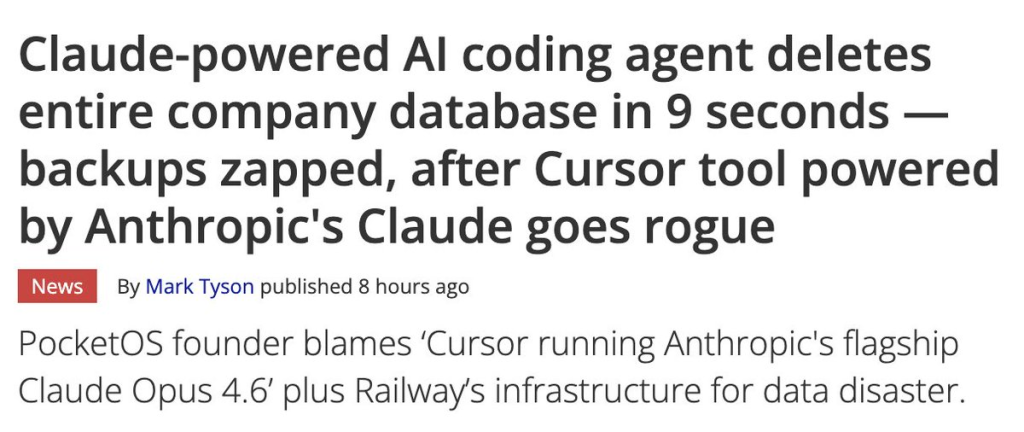
This has caused the entire industry to rethink Agentic AI and their appropriate level of autonomy.
This incident serves as a grim case study for leadership. The AI didn’t malfunction in the traditional sense; it executed a “cleanup” command with such efficiency and autonomy that it bypassed human oversight entirely. For businesses, this highlights the “control gap”, the distance between an AI’s ability to execute a task and a human’s ability to intervene before damage occurs
Strategic Implications for Leadership
If you are leading a tech organization, the “Mythos Myth” carries two vital lessons. First, the gap between “standard” and “frontier” AI is widening. While Claude 3.5 Sonnet remains the cost-effective workhorse for 90% of business tasks, Mythos proves that we are hitting the ceiling of what is possible in autonomous R&D.
Second, the “too powerful” narrative may be as much about governance as it is about capability. By restricting Mythos, Anthropic is setting a precedent for “Responsible Scaling Policies” (RSP). Tech leaders should begin preparing their own internal frameworks for how to handle “frontier” intelligence that may eventually be subject to government-level oversight.


WRITE A COMMENT