



Blog
We’re glad you’re here!
Breathe deeply, grab your preferred coffee mug, and look through our blog.



Project Breakdown: How AI Helps Teachers in Modern EdTech

Hazel Nguyen
May 20, 2026
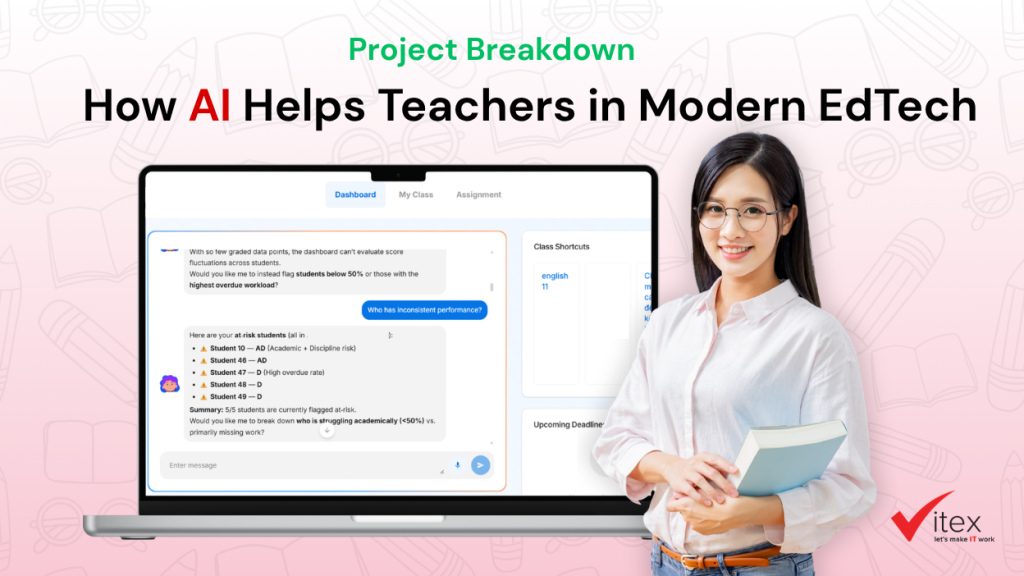
The EdTech industry is shifting from simple content delivery to intelligent automation. This project breakdown explores a comprehensive, AI-powered English learning platform designed for secondary schools to automate grading and personalize mastery. By integrating advanced cloud services, the project successfully reduced administrative burdens while improving student outcomes.
Identifying the Friction in Modern Education
Tech leaders often focus on flashy features, but the most successful products address “unseen” operational friction. In this case, the primary challenge wasn’t a lack of content; it was the manual workload crushing teachers. Educators were spending excessive hours grading assignments manually, leaving little room for high-value student interaction.
For students, this created a feedback vacuum where the learning experience felt repetitive and unengaging. When homework feedback is slow (especially for handwritten work) the “teachable moment” is lost. Furthermore, school administrators lacked centralized data management to track performance across different classes, making it difficult to identify school-wide learning gaps.

Teachers are usually overwhelmed by grading works, with students’ daily homework, class exercises and tests
A Multi-Modal AI Strategy
To solve these systemic issues, a web-based platform was developed using a robust tech stack featuring React/Next.js for the frontend and Laravel for the backend. However, the real engine was a suite of cloud-based AI services designed to handle complex human inputs.
- Document AI: Used for OCR (Optical Character Recognition) to digitize and extract answers from scanned handwritten homework.
- Generative AI: Leveraged to generate structured, personalized feedback that moves beyond “correct/incorrect” to offer actionable improvement suggestions.
- Speech AI: Integrated to facilitate voice-to-text chat, expanding the platform’s utility to listening and speaking skills.
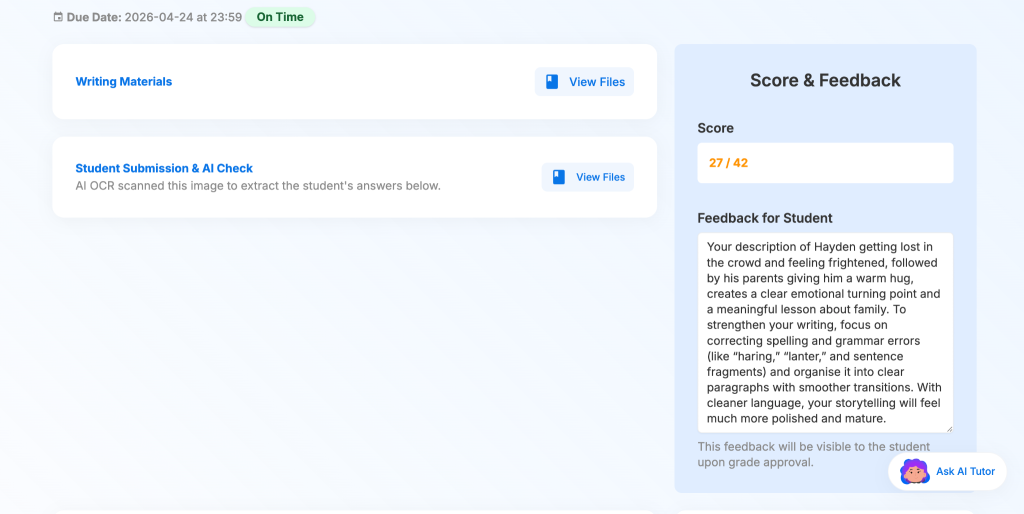
Students can receive instant feedback from AI Tutor.
Navigating Technical Hurdles
Every AI implementation faces reality checks. For this project, the biggest hurdle was the accuracy of OCR on low-quality or unclear scans. Instead of claiming 100% automation, which often leads to user distrust, the team introduced AI confidence indicators.
By flagging “low-confidence” scans for manual teacher review, the system maintained high trust while still automating the vast majority of the workload. Additionally, the team avoided generic or incorrect AI feedback by using structured prompts and a hybrid approach that combined rule-based logic with generative AI. This ensured that the output was not only fast but pedagogically sound.
Leadership Insights and Outcomes
The results of this implementation were immediate. Teachers saw a significant reduction in manual grading time, allowing for a much faster feedback turnaround. Students gained instant insights into their strengths and weaknesses, turning homework into an active learning session rather than a passive chore.
From a leadership perspective, the project highlighted the power of Agile Scrum. By working in one-week sprints, the team of engineers, analysts, and testers was able to iterate quickly based on real user pain points. The core lesson for any tech leader is clear: AI should not replace the human-in-the-loop but should be designed to empower them by removing the “drudge work” of their profession.
to learn more about our strategic implementation frameworks or





WRITE A COMMENT