



Blog
We’re glad you’re here!
Breathe deeply, grab your preferred coffee mug, and look through our blog.



AI Washing: The $55,000-Job Lie Reshaping Hiring

Hazel Nguyen
May 7, 2026
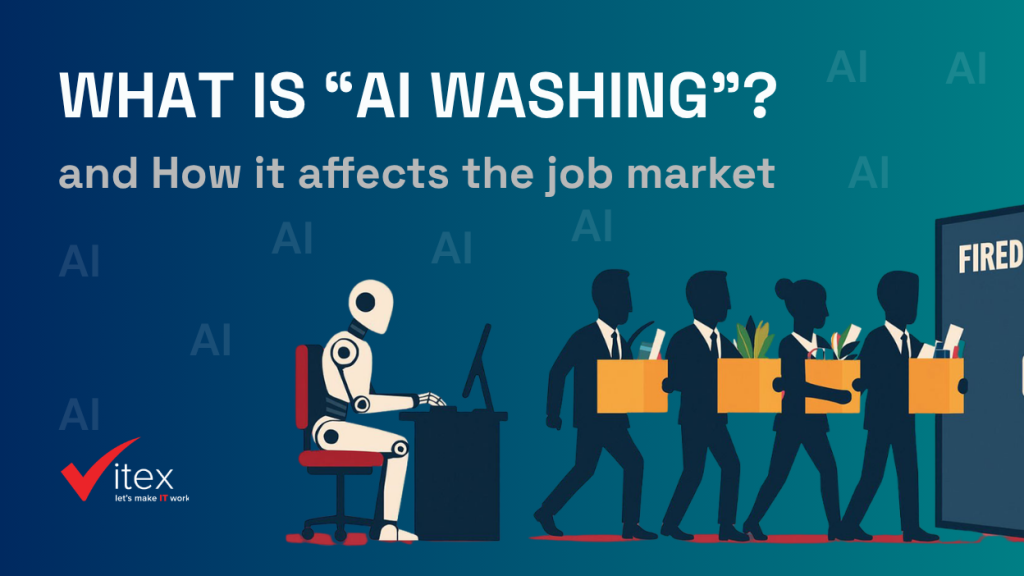
“AI washing” is a business risk. Companies are increasingly misrepresenting how much AI they actually use, whether to attract investors or justify layoffs. For tech leaders, understanding this phenomenon shapes hiring decisions, investor trust, legal exposure, and your company’s long-term credibility.
What Is AI Washing?
The term borrows from “greenwashing”, when companies fake environmental credentials to look responsible. AI washing works the same way: companies either exaggerate how much AI they’re using or, more recently, blame AI for decisions that have nothing to do with it.
There are two distinct faces to this problem. The first is the investor-facing version: overstating AI capabilities in earnings calls, product pitches, and marketing materials to appear more innovative and valuable. The second (and increasingly prominent) version is workforce-facing: citing AI as the reason for layoffs when the real drivers are financial pressure, pandemic-era over-hiring, or simple cost restructuring.
The Numbers Tell a Complicated Story
Here’s where it gets important for leaders to pay close attention, because the data is being distorted on all sides.
In 2025, employers announced more than 1.2 million job cuts – the most since 2020. Of those, AI was cited in nearly 55,000, or 4.5%, according to research firm Challenger, Gray & Christmas. That sounds significant. But dig deeper and the picture changes.
Amazon’s CEO Andy Jassy initially pointed to generative AI as a reason for slashing around 30,000 corporate jobs, then laters clarified that those cuts were “not really AI-driven, not right now at least.” Salesforce’s Marc Benioff cited AI in cutting 4,000 customer support roles. Yet Benioff also turned around and announced he was hiring 1,000 new graduates, saying AI wouldn’t kill entry-level jobs.
Meanwhile, a Yale University Budget Lab analysis of U.S. labor market data from 2022 to 2025 found no significant shifts in occupational mix since ChatGPT’s debut. Sander van’t Noordende, CEO of Randstad (the world’s largest staffing firm) said at Davos that those 50,000 AI-attributed job losses are “not driven by AI, but by general uncertainty in the market.”
In contrast, roughly 119,900 AI-related roles were added in 2024, far exceeding confirmed AI-driven losses of around 12,700. The real story is that AI is reshaping work, not eliminating it wholesale. AI washing distorts that nuance and makes it harder for leaders to act on accurate information.
Why Companies Do It And Why It’s Risky
The incentives to AI wash are obvious. For a few years, simply putting “AI” in your annual report earned an immediate bump in investor sentiment, according to Ravin Jesuthasan, a future-of-work expert at Mercer. And when layoffs are needed, “AI made us do it” sounds cleaner, and less PR-damaging, than “we over-hired in 2021.”
But the tide is turning. Regulators are paying close attention.
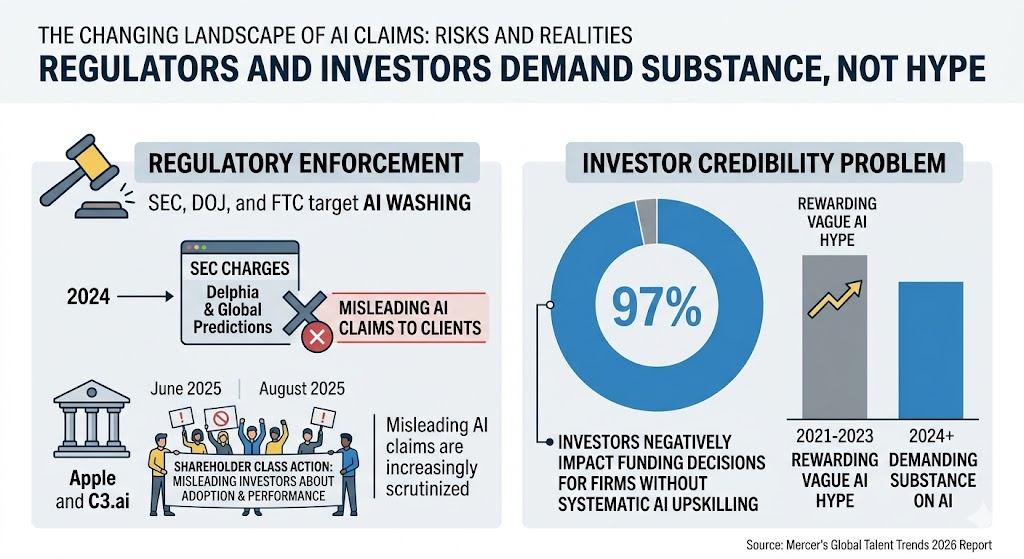
The SEC has been actively targeting AI washing, charging companies for false and misleading AI claims. In 2024, the SEC charged two investment advisory firms, Delphia and Global Predictions, for misrepresenting their use of AI to clients. Apple faced a shareholder class action in June 2025. C3.ai faced a similar class action in August 2025 for misleading investors about its AI adoption and performance. The DOJ and FTC have joined the SEC in escalating enforcement efforts targeting misleading AI statements.
Beyond legal exposure, there’s an investor credibility problem. An overwhelming 97% of investors say funding decisions would be negatively impacted by firms that fail to systematically upskill workers on AI, according to Mercer’s Global Talent Trends 2026 report. The era of rewarding vague AI hype is over. Investors now want substance.
What It’s Actually Doing to the Job Market
For tech leaders, the workforce implications are the most operationally relevant, and the most misunderstood.
AI washing creates a false narrative that discourages strategic hiring. When leaders believe AI has already replaced large swaths of roles (because headlines say so), they pull back on entry-level hiring, reduce training investment, and stall the very workforce development that would help their companies compete. Surveys show 66% of enterprises are already reducing entry-level hiring due to AI, even though the evidence of AI-driven displacement at that scale simply does not exist yet.
Meanwhile, the real AI-driven shift (the one leaders should actually be preparing for) is quieter and more structural. Around 60% of workers will see significant task-level changes due to AI integration. That’s not mass unemployment. It’s mass role evolution. The jobs aren’t disappearing; they’re changing shape.
Roles that combine human judgment with AI tools (financial analysts, software developers, information security analysts) are seeing strong growth precisely because of high AI exposure, not in spite of it. The leaders who will win the next decade are those building workforces that can adapt alongside AI, not those making decisions based on inflated displacement narratives.
What Tech Leaders Should Actually Do
First, get honest internally. Audit what AI is genuinely doing inside your company versus what you’re claiming it does. The gap between those two things is your legal and reputational risk surface.
Second, stop using AI as a catch-all justification for restructuring. If you’re cutting jobs because of over-hiring, economic pressure, or strategic pivot, say that. Deutsche Bank analysts flagged “AI redundancy washing” as “a significant feature of 2026”, and employees, candidates, and regulators are watching.
Third, invest in genuine AI capability-building. Lifelong learning and upskilling are now a top priority for 75% of U.S. employers, because the real competitive advantage isn’t claiming to use AI. It’s actually using it well, and building the human skills that make it effective. Over three-quarters of investors say they’re more likely to back companies that provide AI education to employees. That’s a clear signal.
The Bottom Line
Read more about companies that laid off people claiming because of AI. AI washing is not a victimless PR exercise. It distorts hiring markets, misleads investors, demoralizes workforces, and is increasingly triggering regulatory consequences. More importantly, it distracts leaders from the real work: understanding what AI can genuinely do today, preparing teams for what it will do tomorrow, and building organizations that are honest enough to tell the difference.
The companies that will lead the next five years are not those that talked the most about AI. They’re those that used it honestly, built for it strategically, and told the truth along the way.
Want to understand how to build an AI-ready team without the hype?





WRITE A COMMENT