



Blog
We’re glad you’re here!
Breathe deeply, grab your preferred coffee mug, and look through our blog.



Losing 97% of Players? 5 Retention Strategies That Work

Hazel Nguyen
June 8, 2026
- Most games bleed players silently. The data is brutal: fewer than 3% of users are still playing 30 days after they installed your game. B
- But the games that crack retention (Roblox, Candy Crush, Clash of Clans) aren’t just lucky. They use a specific, replicable set of mechanics.
Here are the five that matter most, with the data to back them up.
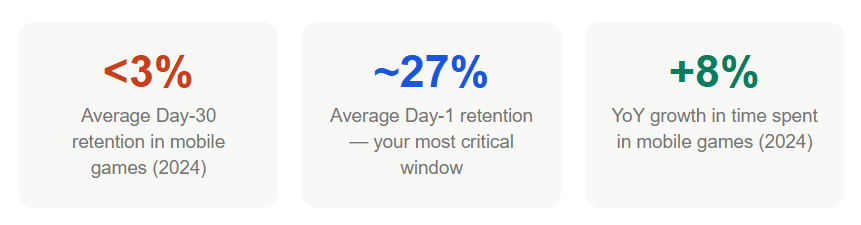
There’s a counterintuitive trend happening in the gaming market right now. Downloads are falling, global installs dropped roughly 7% to 49 billion in 2024, yet players are spending more time per game, not less. Time spent in mobile games grew 8%, and sessions jumped 12% year over year.
What that tells you is that the market is maturing. Players are getting selective. They’re committing to fewer games but going deeper into them. For a tech leader, that’s both a threat and an opportunity: the games that earn loyalty are pulling ahead dramatically, while those that don’t are becoming invisible.
So what separates the games that hold players from those that don’t? The answer is rarely about graphics or genre. It almost always comes down to five mechanics, and whether you’re executing them well.
Why retention, not acquisition?
It’s tempting to focus on downloads. Downloads are visible, trackable, and feel like momentum. But downloads without retention are an expensive way to fill a leaky bucket.
Consider: the average mobile game spends heavily on user acquisition, then watches over 73% of players disappear within 24 hours. By day 7, you’ve typically lost 92% of your install base. The small slice that remains past day 30 (under 3% on average) is where the monetization actually happens. These are the players who buy, subscribe, and bring their friends.
In short, retention is a multiplier on everything else you spend. A 5% improvement in day-30 retention can dramatically outperform doubling your acquisition budget. That’s the lens through which every strategy below should be read.
The 5 strategies that move the needle
Strategy 01
Nail the first session, onboarding is your highest-leverage moment
Day-1 retention is the single most important metric in gaming. Get it above 30% and everything downstream improves. Lose it, and no amount of live events or push notifications will save you.
The mistake most teams make is treating onboarding as a tutorial. It isn’t. It’s a value demonstration. Within the first five minutes, players need to feel competent, curious, and slightly hooked. That means getting them into the core gameplay loop as fast as possible, minimizing menus, instructions, and friction. Interactive tutorials that let players do rather than read consistently outperform passive ones.
What the data shows: Among the top-performing mobile games in 2024, Day-1 retention reached 31–33% on iOS and 25–27% on Android. Games hitting these benchmarks had significantly tighter, more interactive onboarding flows.
One practical test: time how long it takes a new user to experience their first win, their first successful action that makes them feel good. If it’s longer than 90 seconds, you likely have an onboarding problem, not a design problem.
Source: MAF.ad — Mobile Game Retention Benchmarks, 2024
Strategy 02
Build reward loops that bring players back daily
The games with the highest long-term retention aren’t necessarily the most exciting ones. They’re the ones players feel a subtle pull to return to, even when they’re not actively thinking about them.
This is what behavioural scientists call a compulsion loop: a structured cycle of action, reward, and anticipation that makes engagement habitual. In practice, the most effective implementations include daily login rewards, progress streaks, and variable-ratio reward schedules, where outcomes are partially unpredictable, which keeps engagement higher than fixed rewards would.
Key insight: Daily login systems are designed to create a specific routine: players open the game each day to collect a reward, which is reinforced by progress systems that reward consistency over time. The most retentive games layer multiple systems — a daily reward, a weekly milestone, and a longer-term progression track — so there’s always something approaching.
Battle passes are a strong example of this at scale. When players pay for a pass, they’re implicitly committing to playing regularly to unlock its value. That commitment itself is a retention mechanic — they’ve invested money and have an incentive to extract it through continued play. This strategy is also being developed to be accessible in V-Fantasy – Vitex’s In-house Product!
Strategy 03
Use live events to create urgency, and community
Static games plateau. Players exhaust the content, and without new reasons to return, they drift. The solution the most successful games have converged on is the live operations model: a continuous programme of time-limited events, seasonal content, and community challenges that give players fresh reasons to show up.
The critical word is “time-limited.” When content is always available, there’s no urgency to engage now. When a special event runs for 10 days, whether it’s a seasonal character, a limited reward, or a collaborative challenge, the psychology of scarcity kicks in. Players who might have taken a break feel pulled back.
Real-world proof: Roblox reported around 76 million daily active players and 129 million monthly users in 2025. Much of this extraordinary retention is attributed to a constant stream of developer-created events, limited-item drops, and community moments that give players perpetual novelty without requiring a full content overhaul.
For leaders, the operational implication is clear: live events aren’t a marketing feature, they’re a product feature. They require a dedicated team cadence and a content calendar just like any other part of the product roadmap.
Source: Amra & Elma — Mobile Game Marketing Statistics, 2025
Strategy 04
Make it social, players with friends don’t churn
One of the clearest patterns in gaming retention data is this: players who have social connections inside a game churn at significantly lower rates than solo players. When leaving a game means losing progress and means leaving people, the calculus changes.
Social mechanics don’t have to mean multiplayer. At their simplest, they mean leaderboards among friends, the ability to share progress, guilds or alliances that create a sense of belonging, or cooperative challenges that require coordination. Each of these adds a social layer that makes the game feel less like an app and more like a place.
Why this matters for leaders: Social features also dramatically reduce your need to spend on re-engagement. When players are embedded in a community, they re-engage each other organically. The friend group becomes your retention system.
Last War: Survival is a compelling case study. Its alliance-driven social ecosystem was central to its growth from $287,000 in revenue at launch (August 2023) to $138 million per month by December 2024, a 360% revenue increase driven in large part by social stickiness. Players recruited their own networks.
Strategy 05
Re-engage lapsed players with personalised, timely outreach
Every game loses players. The question is whether those losses are permanent or recoverable. A meaningful share of churned players can be re-activated if you reach them at the right moment with the right message, and if you haven’t waited too long.
Push notifications remain the most direct re-engagement channel, but they’re easy to get wrong. Bombarding players with generic alerts degrades the relationship and drives opt-outs. What actually works is segmented, behaviour-triggered communication: a message tied to a specific in-game event they participated in, a personalised offer based on their play history, or a notification triggered by a friend’s activity.
The distinction that matters: Push notifications outperform email for re-engagement because they appear directly on a player’s lock screen and aren’t filtered by spam systems. But their effectiveness degrades rapidly with overuse. The rule of thumb: fewer, smarter messages consistently outperform high-volume blasting.
For enterprise teams, this means investing in behavioural segmentation infrastructure — knowing not just that a player lapsed, but why, and crafting re-engagement that speaks to that specific drop-off point. A player who stopped during a hard difficulty spike needs a different message than one who simply got busy.
The common thread: systems, not features
Looking across all five strategies, the pattern is clear. Retention isn’t a feature you add, it’s a system you build. Each of these mechanics works because it creates a structural reason to return: a daily ritual, a social obligation, a time-sensitive event, a compelling habit. Stack them, and the effect compounds.
The inverse is also true. A game can have beautiful art, tight core mechanics, and a strong IP, and still bleed players, if the structural hooks aren’t there. The gaming graveyard is full of technically excellent titles that failed on retention, not quality. Supervive is a recent cautionary example: a well-reviewed battle royale that introduced a controversial progression system in its 1.0 release, received overwhelming negative feedback from its own community, and shut down just months later.
For tech leaders, this is ultimately a product strategy question, not just a game design one. Where retention sits in your roadmap, who owns it, how it’s measured, these decisions shape whether your game becomes a durable business or a one-time download.
The data says most games lose the battle at day 1. But the data also says that engagement per retained user is growing. Players who find a game they love are going deeper than ever. Your job is to be the game they love.
Ready to improve your retention metrics?
Whether you’re building a new game, in your MVP Phase, we can always help you develop your features and systems further.






WRITE A COMMENT