



Blog
We’re glad you’re here!
Breathe deeply, grab your preferred coffee mug, and look through our blog.



Will AI Eliminate IT Outsourcing?

Hazel Nguyen
May 20, 2026
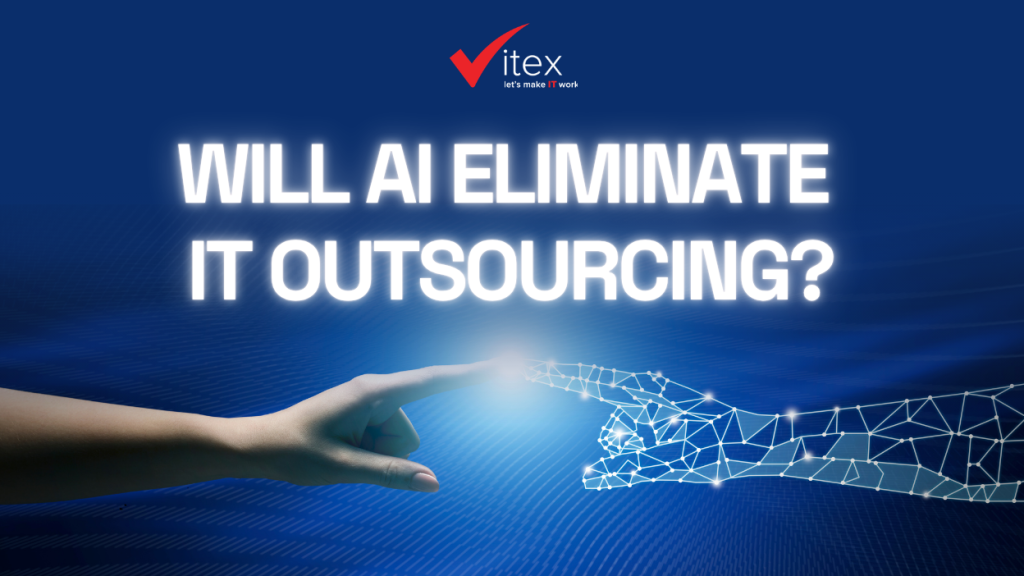
AI is automating tasks that once drove outsourcing demand. But the data tells a more nuanced story, outsourcing isn’t dying, it’s shifting. Tech leaders who understand this shift will be the ones who actually benefit from it.
The Question Every Tech Leader Is Asking
If AI can write code, manage infrastructure, detect security threats, and run 24/7 without a salary, why would you still outsource IT?
It’s a fair question. And given how fast things are moving, it’s one you should be taking seriously. But here’s the thing: the answer isn’t as simple as “AI wins, outsourcing loses.”
The reality is messier.

Currently, AI still needs humans in the loop to operate smoothly, which means there is still lots of room for IT Vendors.
What the Numbers Actually Say
Let’s start with the market. Statistics show that the global IT outsourcing market hit $588 billion in 2025 and is projected to reach $806 billion by 2030 at a 6.5% annual growth rate. That’s not the trajectory of a dying industry.
At the same time, AI is clearly changing the cost structure of IT work. McKinsey estimates that AI could technically automate activities accounting for 57% of U.S. work hours by 2030. And a Gartner survey of over 700 CIOs found that by 2030, zero percent of IT work will be done by humans without AI, with 75% done by AI-augmented humans and 25% by AI alone.
So it is true that AI is more involved in IT work, but replacing humans? That’s a long way to go.
What AI Is Actually Replacing (And What It Isn’t)
AI is genuinely good at the repetitive, rules-based work that used to make up a big chunk of outsourcing contracts: ticket routing, basic code generation, data entry, invoice processing, system monitoring. Tools like UiPath and Automation Anywhere are already handling these tasks at scale.
So who is at risk? If your outsourcing arrangement is mostly about cheap labor doing predictable tasks, AI is coming and replacing you.
But that’s a smaller slice of the IT outsourcing pie than most people assume.
The bigger drivers of IT outsourcing in 2025 are access to specialized talent, cybersecurity expertise, AI implementation support, and cloud modernization, none of which AI can fully self-serve. In fact, 92% of organizations now expect their outsourcing vendors to integrate AI into service delivery. They’re not replacing vendors with AI, they’re demanding that vendors bring AI to the table.
The Talent Gap That AI Can’t Close (Yet)
Here’s a dynamic that doesn’t get enough attention: AI is creating more demand for skilled IT professionals, not less.
Gartner predicts that by 2028, 90% of enterprise software engineers will use AI coding assistants, but their role will shift from writing code line by line to orchestrating AI systems, reviewing AI-generated output, and making architectural decisions. You still need people for that. Just different people, with different skills.
And those people are in short supply everywhere. That’s exactly where outsourcing partners fill the gap. 46% of businesses already outsource technology services, with 42% more considering it in the next 12 months, largely because they simply can’t find or afford the talent in-house.
Cybersecurity is a particularly sharp example. Cybercrime damage costs are expected to hit $10.5 trillion annually by 2025, and the skills needed to defend against sophisticated attacks don’t come from a prompt. They come from experienced security professionals, most of whom are found through specialized outsourcing partners.
The Old Outsourcing Model Is Dead. The New One Is Stronger.
The model that is dying is the pure cost-arbitrage play — sending work offshore purely because labor is cheaper there. Industry analysts are openly declaring this approach obsolete, and rightly so. AI removes much of that labor cost advantage for routine tasks.
What’s replacing it is a model built on outcomes, not headcount. Three out of four companies now want their outsourcing partners to drive transformational outcomes, new business models, technology innovation, and measurable results, not just cost savings, according to KPMG’s 2025 report. And 81% are specifically seeking partners who can function as strategic collaborators, not just transactional vendors.
That’s a fundamentally different relationship. And it’s one where the value of a good outsourcing partner actually goes up in an AI world, because the complexity of what they’re being asked to do has gone up too.
What This Means for Your Strategy
If you’re a tech company leader trying to figure out where to put your chips, here’s the practical takeaway:
Don’t outsource just routine tasks. AI handles those better, faster, and cheaper. If your vendor is still billing you for work that an AI tool could do autonomously, renegotiate or move on.
Do outsource for expertise and scale. AI implementation, cloud architecture, cybersecurity, and specialized software engineering are areas where outside expertise compounds your internal capabilities.
Treat your outsourcing partners as AI accelerators. The best vendors aren’t competing with AI; they’re deploying it on your behalf. Global enterprise AI spending surged over 200% year over year to $37 billion in 2025, the right outsourcing partner already has that infrastructure and expertise. You don’t have to build it from scratch.
The Bottom Line
AI isn’t eliminating IT outsourcing. It’s eliminating the version of IT outsourcing that was already becoming a liability: low-skill, high-volume, task-based work with little strategic value.
What remains is the kind of outsourcing that makes your organization smarter, faster, and more capable than you could be alone. That’s not going away. If anything, it’s becoming more important.
The leaders who will win the next five years aren’t the ones who eliminate outsourcing because AI arrived. They’re the ones who redesign their outsourcing strategy around what AI makes possible.
Thinking through how AI should reshape your IT partnerships? We help tech leaders cut through the noise and build outsourcing strategies that actually work in an AI-first world. Contact us to start the conversation or explore our resources to go deeper.
WRITE A COMMENT