



Blog
We’re glad you’re here!
Breathe deeply, grab your preferred coffee mug, and look through our blog.



Project Breakdown: PlanZ.AI – Fixing the 80% Event Budget Overrun Problem

Hazel Nguyen
June 26, 2026
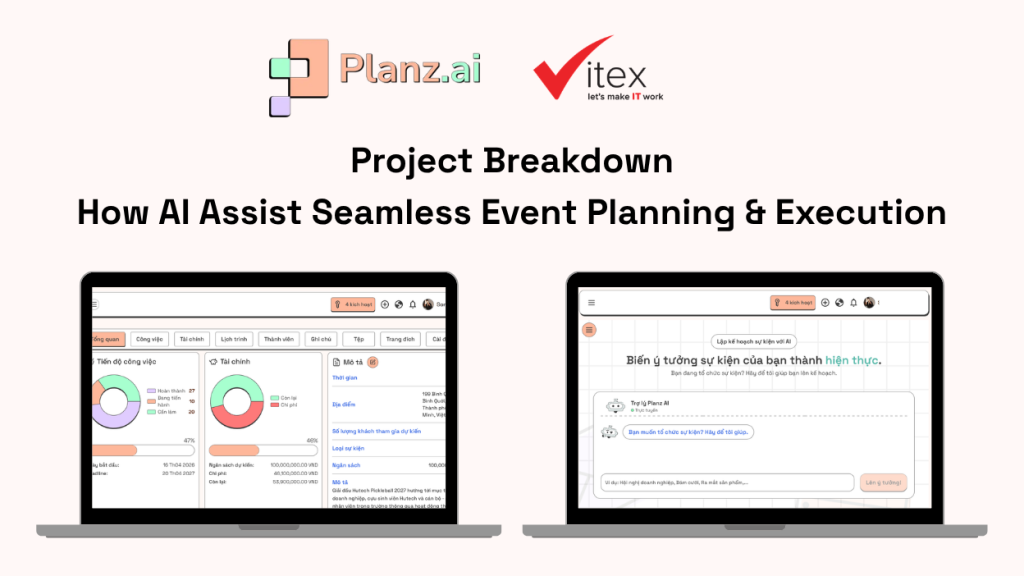
Most corporate events go over budget. Most event teams still run their entire operation across five to seven disconnected tools: a spreadsheet for costs, a Word doc for the script, a group chat for everything else. And most of the people doing this work were never trained as professional planners; they just got the job because someone had to do it.
PlanZ.AI was built to close that gap. It’s an end-to-end AI-powered platform that walks users through the entire event lifecycle, from a small team workshop to a mass-scale festival and it’s a useful case study for any tech leader thinking about where AI actually creates value versus where it’s just a feature bolted onto an old workflow. Here’s what we learned building it.
The Problem: Why Event Planning Still Feels Like Chaos
Before you can fix a workflow, you have to understand why it’s broken. For event planning, four problems keep showing up together.
The first is manual overload.
A huge share of the hours spent on any event project go to low-value admin work: aligning timelines, writing scripts, redoing the same draft three times. None of that creates value; it just eats time that could go toward the actual event.
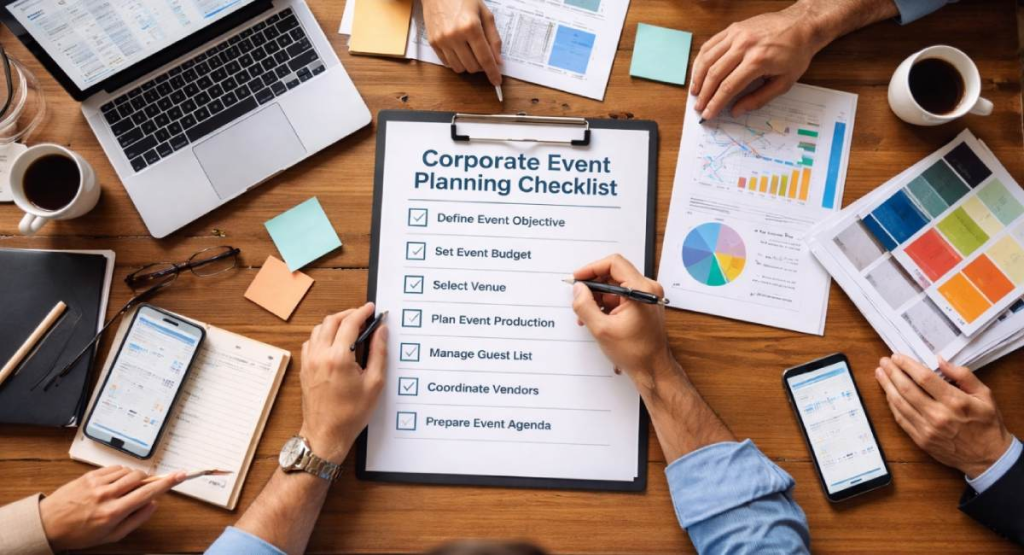
Planning on paper or personal files can cause major loss if information changes are not updated. Source: Ariseevent.in
The second is tool chaos.
Data scattered across Excel, Word, and chat apps means nobody has the full picture. That’s an operational risk. Siloed communication is exactly what causes execution mistakes to slip through unnoticed until they show up live, on-site, when it’s too late to fix them.
The third is the one that should worry any finance lead: budget overruns.
The majority of corporate events exceed their initial financial forecast. Without a real-time vendor database, pricing stays opaque, and teams end up just having to accept the rising costs.
The fourth is an expertise barrier.
Running a polished event takes years of logistics experience. Casual organizers get overwhelmed, and even professional planners rarely have tools that scale with them as the event gets bigger or more complex.
What PlanZ.AI Actually Does
PlanZ.AI’s answer to all four problems starts with one decision: stop adding tools, and consolidate instead. The platform works as a single source of truth, one workspace for tasks, costs, budgets, and notes, replacing the usual five to seven fragmented channels with one integrated workflow. That alone removes most of the “information gap” that, according to industry data referenced in the project’s own research, is behind roughly 90% of event failures.
On top of that consolidated base sits the part that makes PlanZ.AI more than a glorified project tracker: AI support across every phase, from planning through live execution. The goal isn’t to answer questions when asked, it’s to automate the repetitive logistics and administrative drafting that used to eat all those hours, so the people running the event can spend their time on decisions that actually need a human.
A Closer Look: Dual-Phase AI in Action
The AI work in PlanZ.AI is split into two distinct phases, and that split is worth paying attention to, because it reflects a pattern that applies well beyond event planning.
Phase one is the AI Proposal Architect.
It takes a rough idea and turns it into a structured, professional event proposal almost instantly. This is where the platform earns trust early: a clean, credible foundation, generated fast, before the user has invested much time at all.
PlanZ’s Chatbot can help you transform your idea into real plan.
Phase two is the AI Implementation Partner.
PlanZ.AI provides real-time support during live execution, assisting with troubleshooting and operational adjustments. Most AI features stop at phase one. Carrying intelligence into live execution is the harder, more valuable part, and it’s what separates an AI-assisted tool from an AI-first operation.
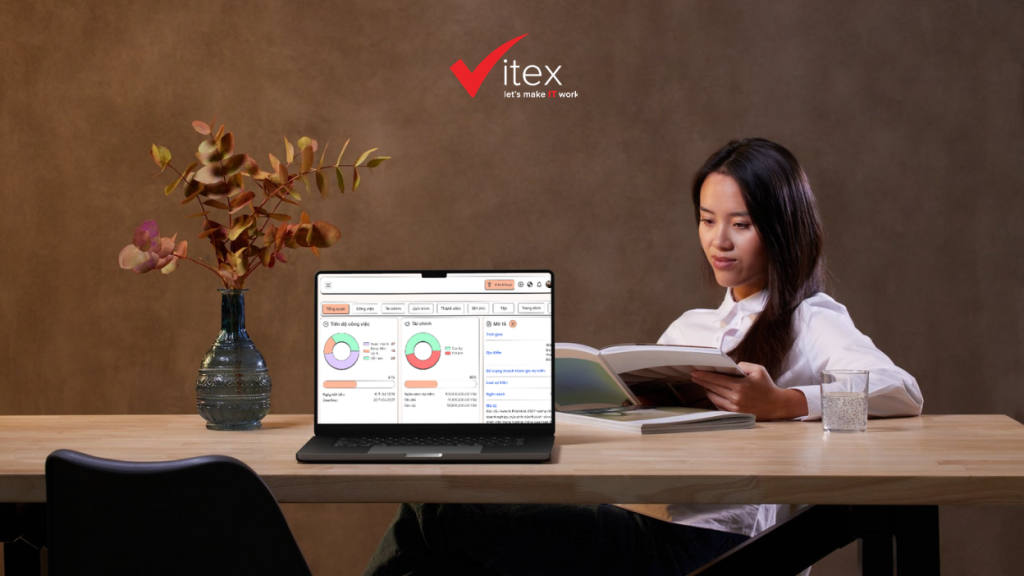
Planner can rest at ease knowing that AI is tracking progress across steps
Around both phases sits a parallel admin control system, giving administrators oversight of user profiles, access levels, and platform-wide activity – the operational backbone that matters once a product moves from pilot to real usage at scale.
In times of crisis, a unified web app can help team trace back root causes and solve problem as soon as possible.
Built Lean, Built to Scale
None of this required an oversized team. PlanZ.AI was built by a focused, ten-person cross-functional group covering backend (PHP), frontend (ReactJS), AI (Python), QA, and product/BA – small enough to move fast, structured enough to ship something production-ready.
The platform itself runs on two surfaces by design:
| A Professional Desktop Website The primary hub for detailed planning, dashboards, and complex scheduling | A Mobile-optimized Web App For real-time, on-the-ground field operations |
The Real Lesson for Tech Leaders
Strip away the event-planning specifics, and PlanZ.AI is really a case study in three decisions that translate to almost any vertical SaaS build.
First, consolidation beats addition.
The instinct when a workflow is messy is often to add a tool to fix it. PlanZ.AI did the opposite, it removed tools by becoming the one place where everything already lives.
Second, AI earns trust through speed before it earns trust through complexity.
The Proposal Architect’s instant draft is a low-risk way to prove the platform’s value before asking users to rely on it during something as high-stakes as live execution.
Third, democratizing expertise is a product strategy.
Translating years of professional logistics know-how into an intuitive, no-code interface is what lets a college student or a small business owner run an event with something close to agency-level structure, and it’s also what makes the product viable for a much bigger market than “professional event planners” alone.
What’s Next
The roadmap pushes further into live AI orchestration: deeper support during the actual organization phase, with the platform eventually predicting operational risks and suggesting fixes in real time, not just reacting after something goes wrong. Alongside that, the scope is expanding to cover the total event lifecycle, from marketplace vendor booking all the way to post-event financial settlement, with the long-term goal of making PlanZ the closed-loop system where booking, contacting, and negotiating all happen in one place.
Having an AI Solution idea in mind?
WRITE A COMMENT